
“The international sales drop dramatically.”
That’s how one UK seller put it in a forum post. Many others say the same.
EU buyers didn’t disappear, though. Germany alone is one of eBay’s biggest markets. They just stopped finding British listings.
This guide shows you the two ways to sell into Europe from the UK. You’ll learn how the eBay International Shipping programme works. You’ll see when to list on eBay.de, .fr and .it directly. And you’ll know what to sort out first: translation, VAT, GPSR and postage.
The easiest start is the eBay International Shipping programme. You post to a UK hub and eBay handles customs, delivery and returns, with no international fee. To win more EU sales, also list your best sellers directly on eBay.de, .fr and .it, translated into the local language. Test one country first.
What “selling on eBay Europe” really means: eBay International Shipping vs listing on eBay.de, .fr and .it
There are two very different ways to reach EU buyers.
Option 1: eBay International Shipping (eIS). This is eBay’s new programme for UK sellers. It replaces the old Global Shipping Programme (GSP). eBay started rolling it out in the UK in August 2026, in phases.
Here is how it works:
- You list on eBay.co.uk as usual.
- eBay makes your eligible listings available to buyers abroad.
- A buyer in Germany buys your item.
- You post it to eBay’s UK hub, with tracking.
- eBay handles customs, international delivery and returns.
The big win: no international fee. And if an international buyer returns an item, eBay refunds them and you keep your payout.
Option 2: Local listings. You create a separate listing on eBay.de, eBay.fr or eBay.it. It’s written in German, French or Italian. It’s priced in euros. You post the item to the buyer yourself.
| eBay International Shipping | Local listing on eBay.de / .fr / .it | |
|---|---|---|
| Language | Your English listing | Local language |
| Who posts abroad | eBay (you post to a UK hub) | You |
| Customs and paperwork | eBay | You and your carrier |
| International returns | eBay refunds, you keep the payout | You handle them |
| Shows up in local searches | Not well. Your title is in English | Yes, in the local language |
| Effort | Low | Higher |
Our advice: use both. Let eIS cover the whole world with zero effort. Then add local listings for your best sellers in the countries that buy most.
Why translated listings on local eBay sites get more views than English ones
German buyers search in German. French buyers search in French.
Someone in Berlin looking for a phone case types “Handyhülle”. Your English title says “phone case”. Your listing may never show up.
That’s the main limit of eIS. Your listing is still written for UK searches.
A local listing fixes this. It has:
- A title in the buyer’s language, with the words people actually search for.
- Item specifics in that language (item specifics are the brand, size and colour fields eBay asks for). eBay.de uses its own values, like “Farbe: Schwarz”.
- A price in euros, so buyers don’t have to guess.
- Postage costs shown up front, for their country.
Don’t use a word-for-word translation tool and stop there. Check the main search terms. “Trainers” in the UK might be “Sneaker” in Germany, not a literal translation.
Here’s a simple before/after:
| English listing (via eIS) | German listing on eBay.de | |
|---|---|---|
| Title | Men’s Leather Wallet Black RFID Blocking Slim Bifold | Herren Geldbörse Leder Schwarz RFID Schutz Slim Portemonnaie |
| Price | £24.99 (converted for the buyer) | €29.90 |
| Matches “Geldbörse Herren”? | No | Yes |
VAT, IOSS and GPSR: what UK sellers must sort out before selling to the EU
This part scares many sellers. It’s simpler than it looks for most eBay orders.
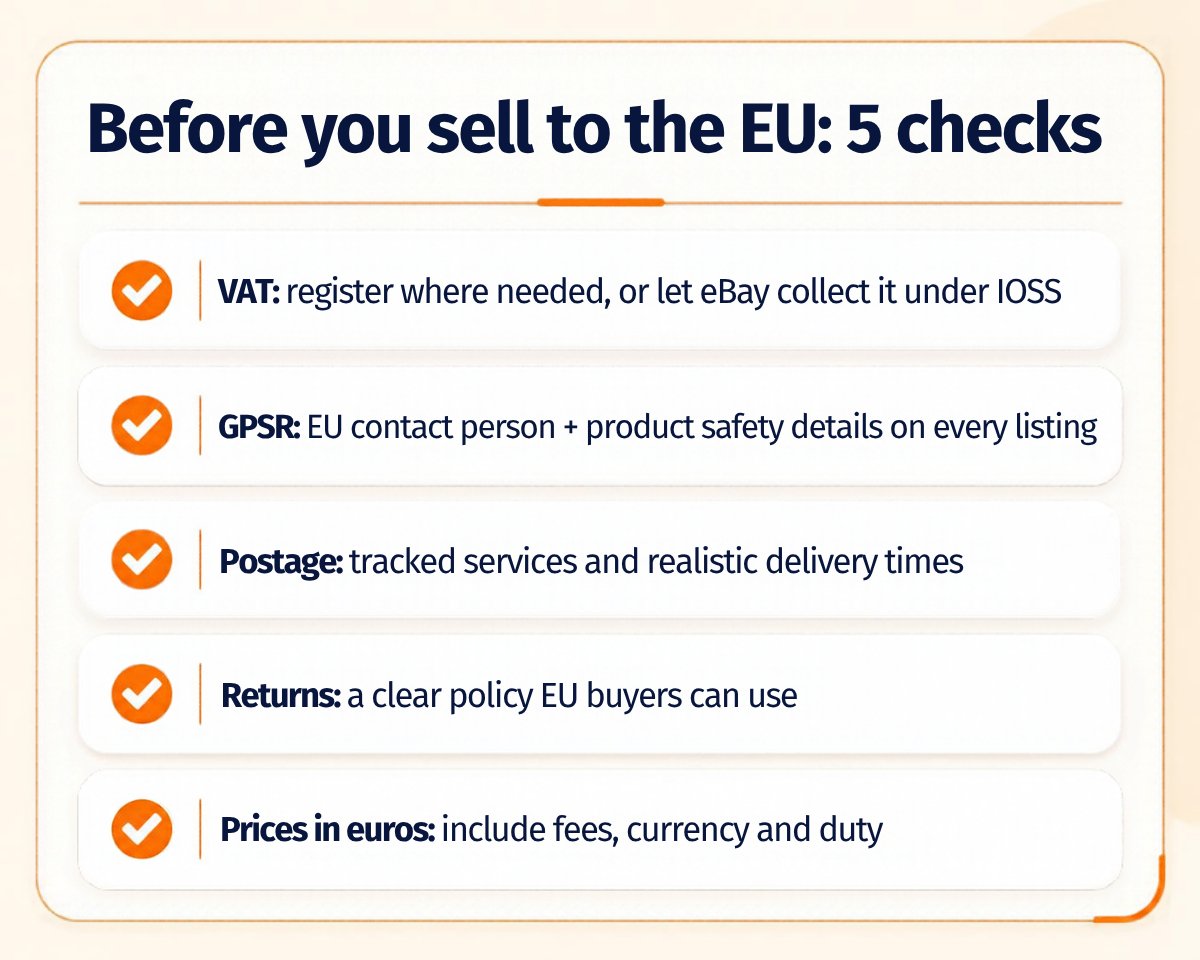
1. VAT on orders up to €150
For parcels worth up to €150, eBay collects the EU VAT from the buyer at checkout. eBay then pays it to the tax office. This uses eBay’s IOSS number (IOSS is the EU’s scheme for collecting VAT on small parcels).
What you must do:
- Don’t charge EU VAT again yourself.
- Give eBay’s IOSS number to your carrier on the customs form. eBay shows it on the order.
- If you skip this, the buyer may pay VAT twice. Then you’ll get a return or bad feedback.
Above €150, the rules change. The buyer usually pays import VAT and fees on delivery. Many sellers keep EU listings under €150 for this reason.
2. UK VAT
Goods you send to the EU leave the UK. They usually count as exports. That means they’re normally zero-rated for UK VAT. eBay’s own eIS help says the same for programme orders.
3. The new €3 EU parcel duty
From 1 July 2026, the EU added a temporary flat customs duty of €3 on low-value parcels. It replaced the old duty-free limit under €150. It’s charged per different item in the parcel.
Who pays it depends on how you ship:
- With eBay International Shipping, eBay handles it. Buyers see import fees at checkout.
- If you post to EU buyers yourself, the carrier may contact the buyer about import fees before delivery.
Surprise fees on the doorstep lead to refused parcels and bad feedback. Build the duty into your euro prices. On a €20 item, €3 matters.
4. GPSR (product safety)
GPSR is the EU’s General Product Safety Regulation. Since December 2024, products sold to EU consumers need safety details. These include the manufacturer’s name and address. If the manufacturer is outside the EU, you also need a “responsible person” based in the EU.
eBay can block listings for EU buyers when these details are missing. Fix this before you expand. Our GPSR guide shows how to add these details to thousands of listings.
Postage and returns from the UK: costs, times and what EU buyers expect
With eIS, postage is easy. You post to the UK hub. eBay sets and charges the international postage to the buyer.
With local listings, you post directly. Here’s what to set up:
- Pick a tracked service. Royal Mail International Tracked, Evri International or a courier. Tracking protects you in disputes.
- Add a customs declaration. Every parcel to the EU needs one. Include the item description, value and eBay’s IOSS number.
- Set clear delivery times. Most UK parcels reach Germany or France in about 3–7 working days. Show a realistic time, not the fastest.
- Offer free postage if you can. EU buyers compare total cost. Build postage into the item price instead.
- Set up returns. EU consumers buying from a business have a legal right to cancel within 14 days. A clear 30-day return policy builds trust.
Pricing in euros without losing money on fees and exchange rates
Don’t just convert your pound price. Your costs abroad are different.
Work out each euro price from these parts:
- Your UK price. Start here.
- Exchange rate. Rates move. Leave a small buffer.
- eBay fees on that site. Local listings pay the local site’s fees. Check the eBay.de, .fr or .it fee page.
- Postage. International postage costs more than UK postage.
- The €3 duty, if it applies to your parcels.
- Round it. €29.90 looks more natural to EU buyers than €28.74.
Here’s an example. The numbers are made up, to show the method.
| Step | Amount |
|---|---|
| UK price | £24.99 |
| Converted at an example rate of €1.15 | €28.74 |
| Add 10% for fees, currency and duty | €31.61 |
| Postage built in (free postage for the buyer) | €38.00 |
| Rounded | €37.90 |
Then check the price against local competitors. Search eBay.de for the same item. If yours is far higher, look at cheaper postage first.
How to test one country first (and expand your best sellers in bulk)
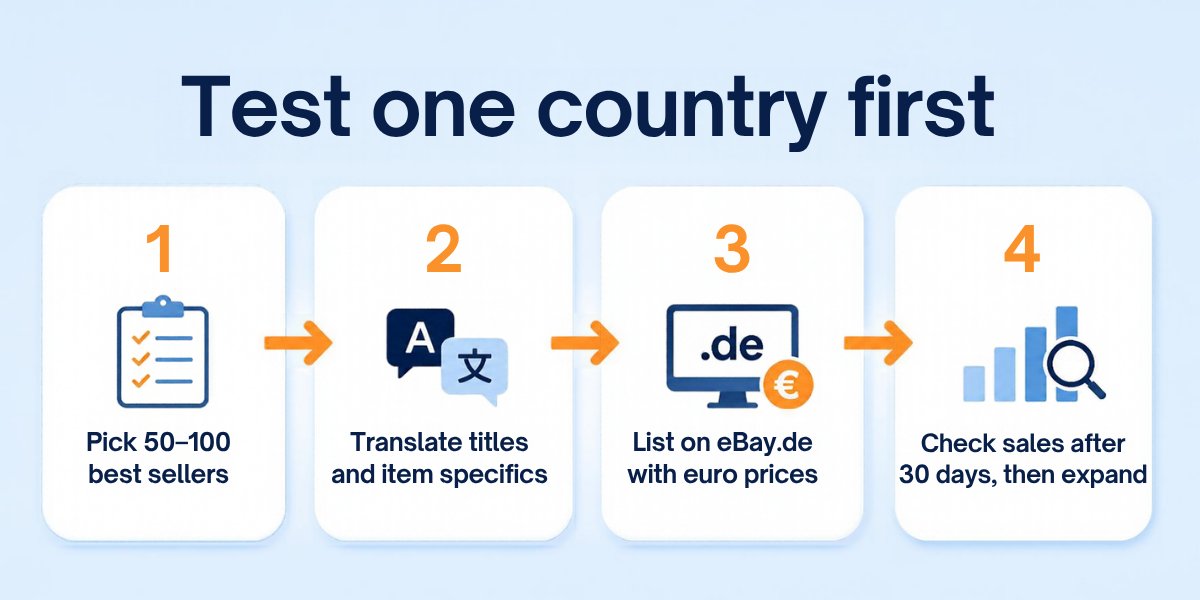
Don’t translate your whole shop on day one. Test first.
- Pick one country. Germany is often the best start. It’s eBay’s biggest market in Europe.
- Pick 50–100 best sellers. Choose items that sell well in the UK, are light to post, and cost under €150.
- Check GPSR details. Every test listing needs them.
- Create local listings. Translate the title, description and item specifics. Set euro prices and postage.
- Wait 30 days. Track views, watchers and sales per listing.
- Expand what works. Add more listings in that country. Then try France or Italy.
Steps 4 and 6 are the hard part. As one seller with a big shop put it:
“I have thousands of listings, so this isn’t something I can realistically go through and fix one by one.”
You select your listings and turn on eBay Germany, France, Italy, Spain or Ireland. Our AI translates the title and description, picks the category and fills the item specifics. You set a markup, VAT and price rounding per country. Stock stays in sync across every eBay site, so you don’t oversell.
FAQ
Is the eBay Global Shipping Programme still running in the UK?+
eBay is replacing it with eBay International Shipping, in phases from August 2026. Eligible GSP sellers are moved across automatically.
Do I need to register for VAT in Germany to sell on eBay.de?+
Not for most orders under €150, because eBay collects the VAT. Storing stock in the EU or selling above €150 can change this. Ask your accountant.
Does eBay translate my listings for me?+
eIS shows your listing to buyers abroad, but it’s still your English listing. To match local searches, create listings in the local language.
What’s the best eBay site to start with outside the UK?+
Germany is usually the best first test. Then France and Italy. Look at where your current international sales come from too.
Which items can’t I send with eBay International Shipping?+
Orders over £900 and items like batteries, e-bikes, alcohol, plants and seeds are restricted. Check eBay’s full list before you rely on it.
Conclusion
Selling to Europe from the UK still works. You just need the right setup.
Turn on eBay International Shipping for easy, low-risk reach. Sort out GPSR and IOSS first. Then test 50–100 translated listings on eBay.de and grow what sells.
Want to expand your best sellers in a few clicks?
SellSetGo puts your best sellers on eBay Germany, France, Italy, Spain and Ireland in bulk, with AI translation and prices set for each country.
Start your 15-day free trialBook a free demo